


Building your own search engine with HTML, CSS, and JS may look quite simple and easy for small websites with a few hundred pages. But if the number of pages is very high – in the order of several thousand to millions of pages like eCommerce sites – it becomes difficult to manage and run the search service as it needs a special technology stack. In this guide, we will walk you through everything you need to know about search engine HTML code for your website – from basic search forms to fully featured search solutions.

What Is Search Engine HTML Code?
Search engine HTML code refers to the HTML, CSS, and JavaScript snippets you embed in your website to give visitors a working search feature. At its simplest, this can be a basic HTML form that sends queries to Google. At its most advanced, it involves JavaScript-powered search engines with autocomplete, filters, analytics, and AI-driven ranking.
Every website with more than a handful of pages benefits from a search engine. Visitors who use site search convert at 2-3 times the rate of those who do not. Adding search engine HTML code to your website helps users find content faster and reduces bounce rates.
Search Tech in Brief
Before diving into code, here is how search engines work behind the scenes:
- Crawler: A bot (like GoogleBot) crawls a website periodically, discovering new and updated pages.
- Parser: Processes the data from the crawler and saves the metadata, rich snippets, schema.org objects, and other structured information.
- Indexer: Reads the parsed data and creates an inverted index (similar to the one you would find at the end of a book) making the search engine retrieve results faster.
- Search Results Ranker: The search engine retrieves many documents and results for every search query. This ranker orders these results based on a relevance score. Google uses an algorithm known as the PageRank algorithm. You can come up with your own scoring algorithm as well.
- Search User Interface: Most users search in browsers or mobile apps through the search engine interface. This is usually built using JavaScript frameworks and is the part you embed into your site with HTML code.
Basic HTML Search Form Code
The simplest way to add a search engine to your website is with a basic HTML form that uses the Google site: operator. This sends the user’s query to Google but restricts results to your domain. Here is the code:
<form action="https://www.google.com/search" method="get" target="_blank">
  <input type="hidden" name="q" value="site:yourdomain.com" />
  <input type="text" name="q" placeholder="Search this site..." />
  <button type="submit">Search</button>
</form>
Replace yourdomain.com with your actual domain. When a visitor types a query and clicks Search, the form appends their term to the site: operator and sends it to Google. Results appear on Google filtered to your website.
This approach works as a quick fix but has significant drawbacks for professional websites.
Why Basic HTML Search Is Limited
While a simple HTML search form gets the job done, it falls short for serious websites:
- No autocomplete or suggestions: Users do not get real-time suggestions as they type, leading to more failed searches and a poor experience.
- No search analytics: You have no visibility into what visitors are searching for, which queries return zero results, or how search influences conversions.
- No custom ranking: You cannot boost or bury specific pages. Google’s algorithm decides what ranks first, not you.
- Ads and competitor links: Google search results pages include ads. Your competitors may appear right next to your own content, causing you to lose traffic.
- Users leave your site: The search happens on Google’s domain, pulling visitors away from your website entirely.
- No filtering or facets: There is no way to add category filters, price ranges, or other faceted navigation that eCommerce and content-heavy sites need.
- No styling control: The results page looks like Google, not your brand. You cannot match your website’s design.
In Google Site Search we created a demo that can be included in the website, including the HTML code. But as you know, Google results will include ads and you may lose your traffic to competitors.
For these reasons, most website owners choose a dedicated site search solution that keeps visitors on their website and provides full control over the search experience.
Adding ExpertRec Search Engine HTML Code to Your Website
ExpertRec provides a Search as a Service solution that is ad-free and you can simply plug-and-play to integrate into your website search in less than 5 minutes. No backend setup or server configuration is required.
Insert ExpertRec Search Engine HTML Code into your website
Steps to Get Search Engine HTML Code Using ExpertRec
- Step 1: Head on to https://cse.expertrec.com and sign up with your Google account.

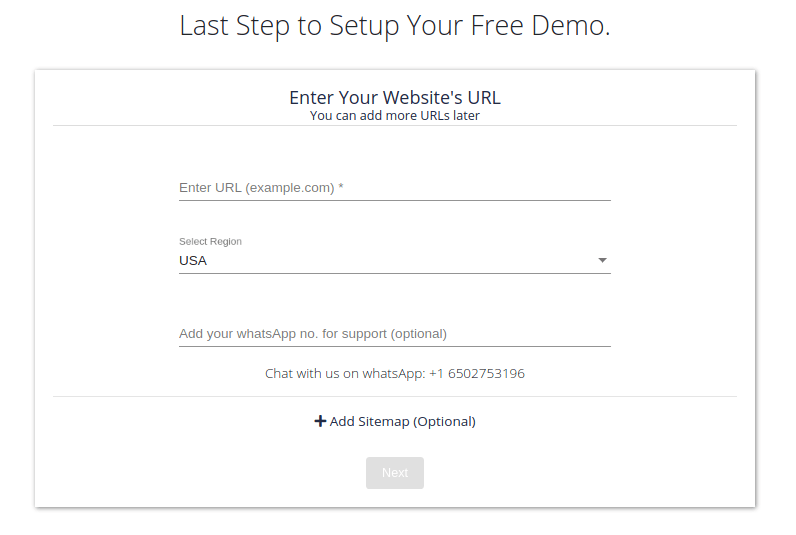
- Step 2: Enter the URL for which the search needs to be created. The system will automatically build a search engine and create the code that needs to be added to your website.
- Step 3: Enter the sitemap URL, if present. This is optional. It will allow the crawler to locate all the pages on your website more effectively, but you can choose to skip this step.
- Step 4: You will receive the search engine HTML code to add to all pages of your site. The code snippet looks like this:
<!-- ExpertRec Search Engine Code -->
<script>
  (function() {
    var defined = 'cse_id'; // your unique ExpertRec ID
    var defined2 = 'cse_key'; // your API key
    var cx = defined + ':' + defined2;
    var gcse = document.createElement('script');
    gcse.type = 'text/javascript';
    gcse.async = true;
    gcse.src = 'https://cse.expertrec.com/api/js/ci_common.js?id=' + cx;
    var s = document.getElementsByTagName('script')[0];
    s.parentNode.insertBefore(gcse, s);
  })();
</script>
<!-- End ExpertRec Search Engine Code -->
Paste this code into the <head> section of every page where you want search to appear. WordPress users can add this to their theme’s header.php or use a header scripts plugin.
- Step 5: You can choose to use an existing search box on your site or add a completely new one.

- Step 6: Preview the demo to see your search engine in action before going live.

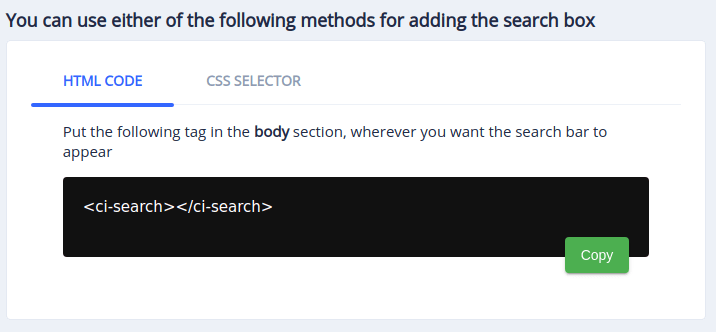

After this code is added to the website, there will be a search feature integrated into the site as shown below:

Comparison: Basic HTML Search vs Google CSE vs ExpertRec
Here is a comparison of three common approaches to adding search engine HTML code to a website:
| Feature | Basic HTML Form | Google CSE | ExpertRec |
|---|---|---|---|
| Setup Time | 2 minutes | 10-15 minutes | Less than 5 minutes |
| Cost | Free | Free (with ads) | From $49/mo |
| Autocomplete | No | Limited | Yes – real-time suggestions |
| Search Analytics | No | Basic | Advanced dashboard |
| Custom Ranking | No | Limited | Full control with rules |
| Ad-Free Results | No (Google ads) | No (shows ads) | Yes – completely ad-free |
| Results on Your Site | No (redirects to Google) | Yes | Yes |
| Filters and Facets | No | No | Yes |
| Custom CSS Styling | Search box only | Limited | Fully customizable |
| AI Merchandising | No | No | Yes |
| Image Search | No | Yes | Yes |
| Voice Search | No | No | Yes |
Customizing Your Search Engine Appearance
Once you have the search engine HTML code installed, you will want to customize its appearance to match your brand:
Search Bar Placement
Place your search bar where users expect to find it. The top-right corner of the header is the most common location. For mobile layouts, a search icon that expands into a full-width bar works best. Avoid placing search in the footer or sidebar where visitors may miss it.
CSS Styling Tips for Your Search Box
You can style the search input field and button with CSS to match your site’s design. Here is an example:
.search-container {
  display: flex;
  align-items: center;
  max-width: 500px;
  margin: 0 auto;
}

.search-container input[type="text"] {
  flex: 1;
  padding: 12px 16px;
  font-size: 16px;
  border: 2px solid #ddd;
  border-radius: 4px 0 0 4px;
  outline: none;
}

.search-container input[type="text"]:focus {
  border-color: #c8232b;
}

.search-container button {
  padding: 12px 20px;
  font-size: 16px;
  background-color: #c8232b;
  color: #ffffff;
  border: none;
  border-radius: 0 4px 4px 0;
  cursor: pointer;
}
ExpertRec Dashboard Customization
With ExpertRec, you can control the search settings – look and feel, suggestions, images, highlighting, search ranking, filtering, and more – all from a visual dashboard. No coding is needed for most customizations.
ExpertRec further enhances searchability with rule-based product promotions, AI merchandising, advanced analytics, fully customizable personalization, and more.

ExpertRec Search Engine Pricing
ExpertRec offers content search plans designed for websites of all sizes. Each plan includes the search engine HTML code, autocomplete, analytics, and full customization options.
| Plan | Monthly Price | Pages Indexed | Search Queries | Best For |
|---|---|---|---|---|
| Standard | $49/mo | Up to 1,000 pages | Up to 50,000 queries/mo | Small blogs and business sites |
| Expert | $81/mo | Up to 5,000 pages | Up to 100,000 queries/mo | Growing content sites and online stores |
| Premium | $159/mo | Up to 10,000 pages | Up to 200,000 queries/mo | Large websites and eCommerce platforms |
All plans include a 14-day free trial. The trial supports one website URL — upgrade to a paid plan to add multiple sites. Sign up for ExpertRec and get your search engine HTML code in minutes.
Insert ExpertRec Search Engine HTML Code into your website
The simplest method is an HTML form using the Google site: operator to restrict results to your domain. For a professional experience with autocomplete, analytics, and custom ranking, use a service like ExpertRec. Sign up at cse.expertrec.com, enter your URL, and paste the generated JavaScript snippet into your header. The entire process takes less than 5 minutes.
Yes, you can use a basic HTML form with Google’s site: operator at no cost. Google CSE is also free but displays ads. For an ad-free experience with advanced features, ExpertRec starts at $49/mo for the Standard plan covering up to 1,000 pages and 50,000 queries per month.
With a basic HTML form, you can only style the input field and button with CSS. With ExpertRec, you get full control over the results page appearance including fonts, colors, layout, and highlighting – all from the dashboard without writing code.
Google CSE is a free tool that displays Google-powered results on your site but includes ads that may show competitor links. ExpertRec is an ad-free search service with real-time autocomplete, analytics, custom ranking rules, AI merchandising, voice search, and faceted filtering – giving you full control over your search results.
A basic HTML form takes about 2 minutes but only redirects users to Google. ExpertRec takes less than 5 minutes – sign up, enter your URL, and paste a single JavaScript snippet into your header. ExpertRec automatically crawls and indexes your pages, so search is ready almost immediately.


